

This article is co-written by Ronald Meeuwissen and Pauline Van Dongen-Deckers. While it’s published under Ronald’s name, the perspectives and insights reflect the shared experience of both authors. Pauline is a certified loyalty specialist who works with international brands to design loyalty strategies and programs that genuinely connect with customers.
A line we still hear in loyalty steering groups goes something like, “Let’s not focus on 60+. They’re not digital. They won’t engage anyway.”
It sounds practical. It feels efficient. And it’s also one of the most expensive assumptions a loyalty programme can make. Because the real issue usually isn’t the 60+ customer.
It’s the programme design. There is, however, huge potential working with this generation!
The assumption: “60+ isn’t a priority segment for loyalty.”
Loyalty teams are under pressure to show growth, fast. That often leads to a familiar prioritization pattern:
- build for the mobile-first user
- design for high-frequency behaviours
- gamify like you’re competing with TikTok
- optimize for the “next generation” customer
The unintended consequence is that we quietly treat older customers as someone else’s problem. Or worse: we treat them as “not addressable.” But the world (and your customer base) has moved on.
Why that assumption doesn’t hold up: the demographic shift is real!
The global population is aging quickly. The World Health Organization (WHO) states that by 2030, 1 in 6 people in the world will be aged 60 or over, and that the population aged 60+ will grow from 1.0 billion in 2020 to 1.4 billion in 2030. By 2050, the 60+ population is expected to double to 2.1 billion.
That’s not a niche. That’s a structural change in the market.
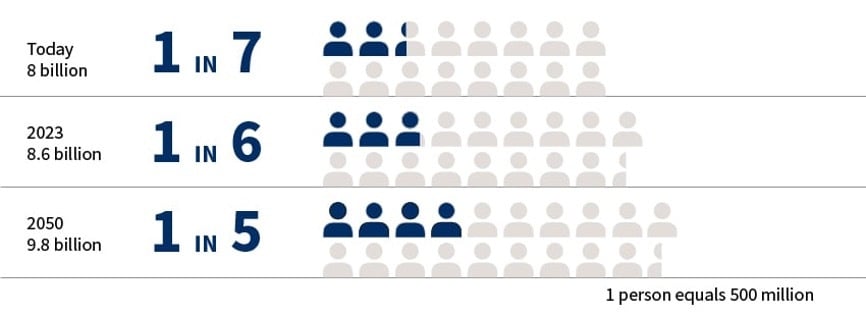
Figure 1: Infographic using the WHO numbers: 1.0B (2020) → 1.4B (2030) → 2.1B (2050).
And if you’re thinking, “Yes, but are they commercially relevant?”. That’s the next myth.
The money and the spend: 60+ isn’t “cute,” it’s powerful.
Here’s a concrete example from the US context: A 2022 consumer insight report on Baby Boomers states that Baby Boomers hold 51% of all wealth in the United States and that their total net worth is nearly $70 trillion.
Now layer in category spending.
A Rothschild & Co./CREDOC-based view (shared in a “Gen Z vs. Silver Gen” slide deck) shows “spending weights for over 50s by consumption sector,” i.e., how much of category spend is carried by the 50+ audience. In the 2025 view:
- Health care: 59.3%
- Food: 57.6%
- Leisure: 54.1%
- Goods & services: 54.2%
- Communication: 52.1%
- Housing: 51.2%
- Total across categories: 50.6%
And the pattern is just as telling in the “lower priority” categories:
- Hotels/Restaurants: 35.9%
- Education: 26.0%
That last one matters. It quietly reminds us that “older customers” are not a monolith. Their spending reflects life stage, priorities, and needs, exactly what loyalty is supposed to respond to.
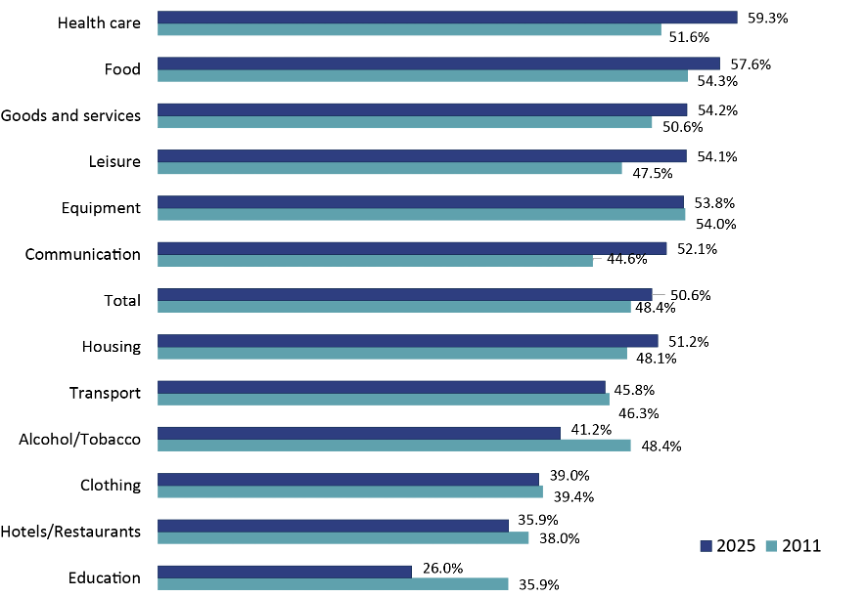
Figure 2: “Spending weights for over 50s by consumption sector” chart, with 2–3 callouts for the biggest categories.
So why do loyalty programmes still under-serve 60+?
Because we confuse “older” with:
- “not digital”
- “not interested”
- “too complex to design for”
- “only motivated by discounts”
- “only doing it for their grandkids”
In practice, what often happens is simpler (and more fixable):
We design programmes with unnecessary friction and then label the resulting drop-off as “low engagement.”
Friction isn’t a UX issue. It’s a loyalty strategy issue.
If value is hard to access, unclear to understand, or too difficult to redeem, the programme stops being a relationship engine and becomes a small obstacle course. And people with high expectations (including many 60+ consumers) will simply walk around it.
The “grandchildren points” stereotype (and other myths) that limit your design
Let’s tackle the common assumptions head-on.
Myth 1: “60+ isn’t digital.”
Reality: many are digitally capable, but they’re less tolerant of clutter and wasted effort.
What tends to work better is not “more features,” but clearer paths:
- straightforward value
- clear navigation
- lower cognitive load
- fewer steps between intent and reward
This isn’t about dumbing anything down. It’s about respecting attention. If your app feels like it needs a training session, you’re not building loyalty; you’re creating abandonment.
Myth 2: “Gamification is only for younger audiences.”
Reality: the psychology of progress doesn’t stop at 60. What often fails is gimmicky gamification: noisy animations, meaningless badges, and “spin-the-wheel for no reason” mechanics. What tends to work is gamification with dignity:
- tier progression
- goal-based rewards
- milestone recognition
- clear “earn and burn” logic
Not childlike. Not patronizing. Just structured progress that feels earned.
Myth 3: “They’re only collecting points for their grandkids.”
Reality: sharing benefits with family can be powerful, but it’s not the only motivation, and it’s rarely the core one. Yes, multi-generational engagement can be a strong lever: a programme becomes more meaningful when benefits can be shared across a household.
But the same source also highlights what this audience values directly:
- convenience
- priority access
- well-being perks
- personal service
- small moments of delight
- opportunities to share benefits with family
In other words, they don’t want “more noise.” They want relevance.
The solution: what 60+ inclusive loyalty design actually looks like
If you want to integrate more 60+ customers into loyalty (without building a separate “senior programme”), the playbook is surprisingly pragmatic.
1) Start with accessibility and simplicity, because it’s good design (and increasingly expected)
Designing for older customers overlaps strongly with designing for accessibility. If you operate in Europe (or serve EU consumers), accessibility requirements are not theoretical: the European Accessibility Act (Directive (EU) 2019/882) becomes applicable to certain consumer services provided after 28 June 2025.
On the practical side, WCAG 2.2 is a widely referenced standard for web accessibility work.
You don’t need a “senior-friendly” interface. You need an interface that’s usable when eyesight, dexterity, attention, or confidence varies, which is true for all your loyalty members.
2) Make value immediate and obvious
For many loyalty programmes, the 60+ customer drop-off isn’t caused by “lack of interest.”
It’s caused by:
- unclear earning rules
- delayed gratification that feels intangible
- redemption that requires too much effort
That can be:
- direct discounts
- clear cashback equivalents
- practical benefits that remove hassle (priority lanes, service perks, reserved timeslots)
3) Build “grown-up gamification”: progress, not gimmicks
If you want engagement mechanics, use the ones that map to real motivation:
- progress to a meaningful tier
- milestone recognition (e.g., “5th visit this month”)
- challenges that feel achievable and relevant
- rewards that aren’t random; they’re earned
The win here is psychological: people don’t just want rewards; they want to feel that their relationship with the brand is seen and valued.
4) Blend digital with human moments
This is one of the most underused differentiators.
Digital should make things easy, but “human touch” still matters:
- in-store recognition
- dedicated service support
- small events or meaningful surprises
In many categories (supermarkets, food service, cinema, petrol convenience), those human moments can be the difference between “transactional repeat” and “real loyalty.”
5) Use family dynamics as an engagement multiplier (without turning it into a stereotype)
Multi-generational value works best when it’s optional and respectful:
- giftable rewards
- shared benefits
- family pooling mechanics
- “invite a family member” journeys
- redemption options that create shared experiences
This is where loyalty stops being an individual mechanic and becomes a household habit.
6) Personalise based on life stage needs, not age labels
The 60+ customer may be:
- still working
- recently retired
- caring for others
- travelling more
- travelling less
- health-focused
- budget-focused
- convenience-focused
The programme should make it easy to get the right value without forcing someone into an “older person” box.
(If you want to strengthen this scientifically, add a short section with market-specific evidence on 55+/60+ smartphone usage and mobile banking adoption in your country.)
Closing thought: the problem isn’t the 60+ audience
The biggest loyalty mistake isn’t that older customers “don’t engage.” It’s that we assume they won’t, and then we quietly design them out. If you build loyalty that is clear, accessible, respectful, and relevant, the Silver Generation doesn’t just participate. They often become your most reliable members!
So, here’s a useful internal question for your next loyalty roadmap session: Where are we creating friction that only “power users” will tolerate?

5 impressive ways to get more loyal customers
In a competitive market, it is crucial to not only attract new customers but also retain loyal ones. Loyalty is an asset of customers, as they not onl …

The customer journey: what is it and how to map it?
A customer journey, also known as a customer journey, is very important for every organization. By means of a customer journey, you map out the needs …

Customer retention software: what to look for and why it matters in 2025
Discover why customer retention is more important than ever in 2025, and what to look for in software that helps keep customers, boost loyalty, and pr …