
Blog
Product Updates
How to Create a Loyalty Program for a Small Business

Kim van der Zande

Running a small business means every dollar has to earn its keep. A loyalty program for small business owners used to feel like something reserved for chains with big tech budgets and dedicated marketing teams. That is no longer true. Modern software has made it possible to launch a structured, engaging program in days, not months, and at a cost that actually fits a lean operation.
This guide walks you through exactly how to do it: what decisions to make first, which mechanics to prioritize, and where technology can replace the manual work that used to make loyalty programs expensive.
Why small businesses need a loyalty program now
Customer acquisition is getting more expensive. Paid social costs more per click than it did three years ago, and word-of-mouth alone rarely scales fast enough. Retention is the cheaper lever.
Research consistently shows that increasing customer retention by just five percent can increase profits by 25 to 95 percent. For a small business, that math is compelling. A loyalty program turns your existing customers into a revenue engine rather than a one-time transaction. If you want to understand the full picture of why retention matters, our piece on customer retention: what it is and why it matters covers the fundamentals in depth.
Beyond revenue, loyalty programs generate data. Every check-in, every redeemed reward, every milestone reached tells you something about your customer. Small businesses that use that data make smarter decisions about offers, timing, and communication.
Step 1: Define your goal before you pick a mechanic
The biggest mistake small business owners make is choosing a mechanic (points, stamps, discounts) before deciding what behavior they actually want to drive.
Ask yourself one question first: what does a loyal customer look like for my business? For a coffee shop, it might be someone who visits four times a week. For a boutique, it might be someone who spends over a certain amount per season. For a gym or spa, it might be someone who books consistently rather than lapsing.
Your goal shapes everything downstream. If you want visit frequency, a stamp card or challenge mechanic works well. If you want higher spend per visit, a tiered points system is more effective. If you want referrals, you need a mechanic that rewards sharing, not just purchasing.
Write down your primary goal before you touch any software.
Step 2: Choose the right loyalty mechanics for your size
Not every mechanic makes sense at every scale. A small business with 200 active customers does not need the same infrastructure as a national retailer. Here is a practical breakdown:
Mechanic | Best for | Complexity | Cost to operate |
|---|---|---|---|
Stamp card (digital) | Cafes, fast casual, salons | Low | Very low |
Points on spend | Retail, restaurants, e-commerce | Medium | Low to medium |
Tiered membership | Gyms, spas, subscription services | Medium | Medium |
Milestone campaigns | Any business wanting engagement spikes | Low to medium | Low |
Challenges and badges | Businesses with repeat purchase cycles | Medium | Low |
Referral rewards | Any growth-stage business | Low | Low |
Gamification mechanics, including challenges, badges, and milestone campaigns, deserve special attention for small businesses. They create emotional engagement that a simple discount program never achieves. When a customer earns a "Coffee Lover" badge after ten visits, or unlocks a free dessert after completing a "Summer Challenge," the reward feels earned rather than given away. That distinction matters for perceived value and for your margin.
NeoDay ships all of these mechanics out of the box, including a member-facing frontend your customers actually see and interact with. You do not need a developer to configure them.
Step 3: Set your rewards structure without giving away margin
Small businesses are often nervous about loyalty programs because they fear the cost of free rewards. That fear is valid if the program is designed poorly. It is manageable if the math is done upfront.
Start with your average transaction value and your gross margin. If your average sale is $20 and your gross margin is 60 percent, you have $12 in room to work with before you touch profit. A reward worth $2 at a cost to you of around $0.80 is sustainable if it drives an additional visit that you would not have otherwise received.
The key principle is that rewards should be funded by the incremental behavior they create, not by behavior that would have happened anyway. A customer who would visit twice a week regardless should not be able to earn your most valuable reward just for doing what they already do. Structure earning so that slightly-above-average behavior gets rewarded, not baseline behavior.
Expiry rules are also your friend. Points or stamps that expire after 90 or 180 days create urgency without being punitive. They also reduce your liability on unredeemed rewards sitting on the books.
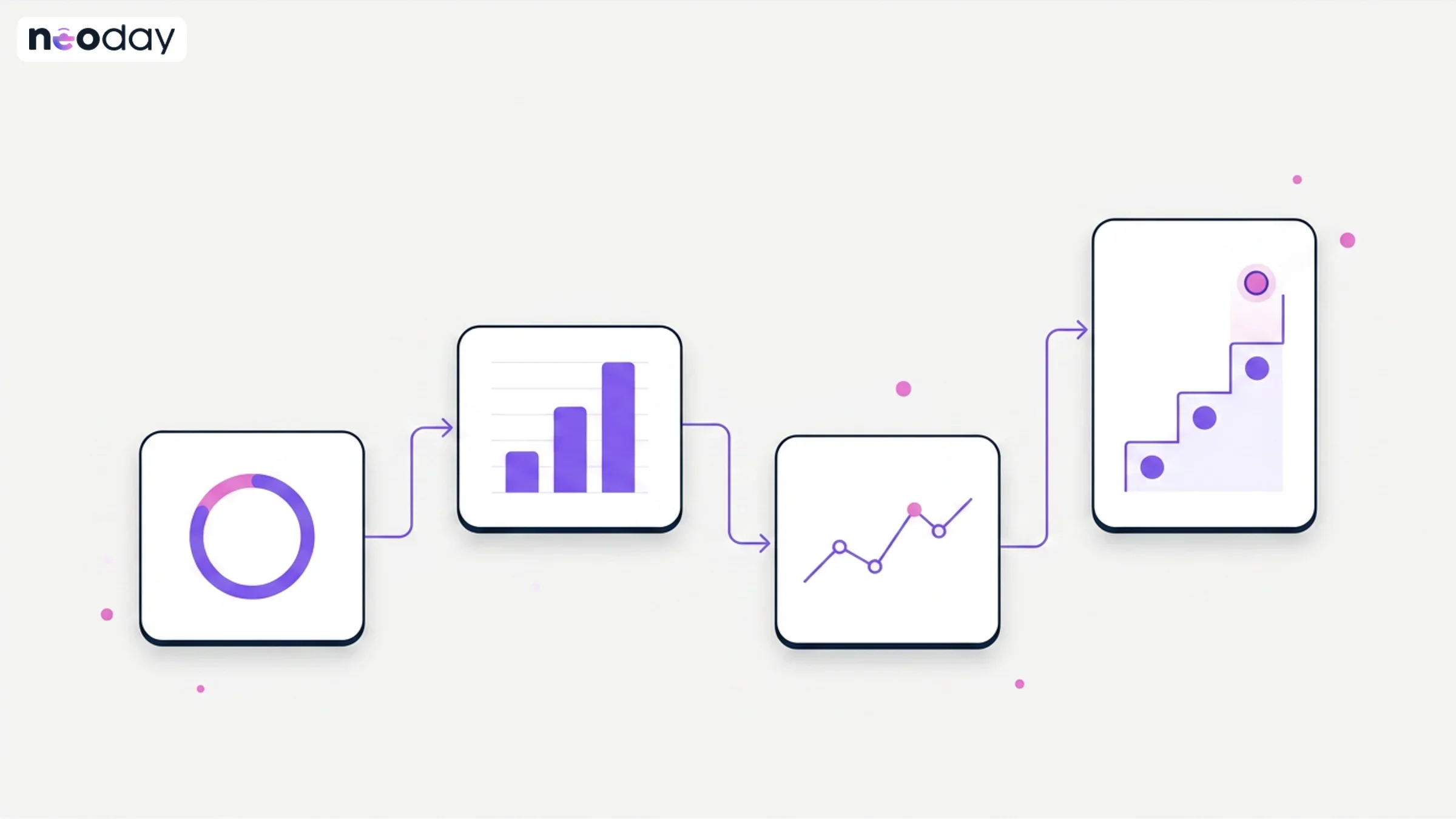
A clear rewards structure helps small businesses control costs while keeping customers motivated to earn.
Step 4: Pick a platform that matches your real needs
This is where most small business owners either overspend or under-invest. There are three broad categories of loyalty software:
Enterprise platforms built for large retailers with complex integrations, dedicated account managers, and five-figure annual contracts. These are not the right fit.
DIY punch card apps that digitize the paper stamp card. They are cheap and simple, but they offer no data, no segmentation, and no engagement mechanics beyond the stamp.
Mid-market loyalty platforms like NeoDay that offer real program mechanics, a member frontend, campaign tools, and integrations, at a price point small businesses can actually afford. This is where most growing small businesses should start.
When evaluating any platform, ask these questions:
Does it include a member-facing experience (app or web portal) or do customers have to use the business's own interface?
Can you run campaigns and challenges, not just points?
Does it integrate with your POS or booking system?
What does the pricing look like at your current customer volume, and what does it look like if you double?
If you are a membership-based business, a gym, studio, or club, the membership card software built into NeoDay is worth exploring specifically. It handles digital membership cards and the loyalty layer in one place.
For retail businesses, it is also worth reading through real loyalty program examples in retail to see how other businesses have structured their programs before you finalize your own.
Step 5: Design the member experience your customers will actually use
A program that nobody joins is worth nothing. The member experience, meaning the interface your customers use to check their points, see challenges, and redeem rewards, is a critical part of program performance.
Several things drive adoption:
Enrollment friction must be low. If signing up takes more than 30 seconds, you will lose a large share of potential members at the door. A QR code at the point of sale that leads to a simple web enrollment form is often enough.
Visibility matters more than most business owners expect. Customers who can see their points balance and how far they are from the next reward visit more often. This is why a member portal or branded app is not a luxury. It is a retention tool.
Push notifications and email are the triggers that bring people back. A message that says "You are 50 points away from a free coffee" is one of the highest-converting pieces of communication a small business can send. Most modern loyalty platforms include this functionality, and it requires no extra cost beyond the platform subscription.
The NeoDay loyalty platform includes a ready-made member frontend so your customers have somewhere to check their progress from day one, without any custom development on your end.
Step 6: Launch small, then iterate
You do not need to launch every mechanic at once. In fact, starting simple is almost always better.
A practical launch sequence for a small business:
Week 1 to 2: Configure points or stamps, set one clear reward, enroll your first 50 to 100 customers manually or through a sign-up campaign.
Week 3 to 4: Analyze early data. Which customers enrolled but never earned? Which earned but never redeemed? These gaps tell you where friction exists.
Month 2: Add one additional mechanic, such as a milestone campaign or a referral reward, based on what you learned.
Month 3 onward: Segment your members and begin testing personalized offers for your most and least active cohorts.
This approach keeps the operational load manageable and lets you validate each mechanic before stacking complexity on top of it.
How loyalty programs for small businesses compare to larger programs
It is useful to understand what you are working with relative to what larger businesses do. The differences are smaller than most people assume.
Feature | Large retailer program | Small business program |
|---|---|---|
Enrollment channel | App, in-store, online | QR code, web form, POS integration |
Points mechanics | Spend-based, tiered | Spend-based, visit-based, or stamp |
Gamification | Challenges, badges, milestones | Same, if platform supports it |
Rewards catalog | Hundreds of options | 3 to 10 targeted rewards |
Data and analytics | Advanced segmentation | Basic cohort and campaign data |
Technology cost | $50,000+ per year | $50 to $500 per month |
Time to launch | 3 to 12 months | 1 to 4 weeks |
The structural difference is scale, not sophistication. A small business using the right platform can run the same types of engagement mechanics that a national chain runs, just with a smaller rewards catalog and a lighter analytics stack.
Restaurant owners specifically can learn a lot from seeing how other operators have approached this. The best restaurant loyalty program examples page covers a range of approaches worth reviewing before you finalize your program design.
Common pitfalls to avoid
A few patterns consistently cause small business loyalty programs to underperform.
Overcomplicating the earn structure. If customers cannot explain how to earn points in one sentence, the program is too complex. Simplicity drives participation.
Setting rewards that are too hard to reach. If your lowest-tier reward requires 30 visits, most customers will disengage before they ever redeem. The first reward should be achievable within 3 to 5 visits for a high-frequency business, or within one to two purchases for a lower-frequency one.
Ignoring the program after launch. A loyalty program is not a set-and-forget tool. It requires at least a monthly review of key metrics: enrollment rate, active member percentage, redemption rate, and average spend per loyalty member versus non-member.
Competing on discount depth instead of experience. Discounts are easily matched by competitors. Experiences, milestones, badges, and personalized offers are not. If your entire program is discount-driven, you are building a habit that is one competing coupon away from breaking.
For businesses that also want to use targeted discounts alongside their points program, exploring dedicated coupon software that integrates with your loyalty layer is worth considering, as it keeps discount distribution controlled rather than broadcast.
Putting it together
A loyalty program for small business does not need a big budget, a developer, or months of planning. It needs a clear goal, a mechanic that matches that goal, a platform that handles the operational work, and a willingness to iterate based on real data.
The businesses that get the most out of loyalty programs treat them as ongoing customer relationships, not one-time campaigns. That mindset, more than any specific mechanic or technology choice, is what separates programs that drive real retention from programs that sit unused.
Start with one mechanic. Enroll your first customers. See what the data tells you. Then build from there.
Sources: Bain and Company, "Prescription for Cutting Costs" (customer retention and profit correlation); Antavo Global Customer Loyalty Report 2024; NeoDay platform documentation; industry benchmarks from loyalty research firm Bond Brand Loyalty.
FAQ: Loyalty programs for small businesses
What is a loyalty program for a small business? A loyalty program for a small business is a structured system that rewards customers for repeat purchases or visits, using mechanics like points, stamps, tiers, or challenges to encourage ongoing engagement and increase retention.
How much does a loyalty program cost for a small business? Most small business loyalty platforms cost between $50 and $500 per month depending on the number of members and features required. Enterprise platforms that cost tens of thousands per year are not necessary for most small businesses.
What is the easiest loyalty program to set up for a small business? A digital stamp card or a simple points-on-spend program is the easiest to configure and for customers to understand. Platforms like NeoDay allow businesses to set these up without any technical expertise in under a week.
Do loyalty programs actually work for small businesses? Yes. Studies consistently show that loyalty program members spend more per visit and visit more frequently than non-members. The key is designing the program around a specific behavior goal rather than offering blanket discounts.
What rewards work best in a small business loyalty program? Free products, service upgrades, and exclusive access tend to perform better than straight discounts because they carry higher perceived value at a lower cost to the business. Gamified rewards like badges and milestone unlocks add emotional engagement beyond transactional value.
How do I get customers to join my loyalty program? Reduce enrollment friction to under 30 seconds using a QR code or POS prompt, offer a small immediate reward for signing up, and train staff to mention the program at every transaction. Visibility and a clear value proposition at the point of sign-up are the two biggest drivers of enrollment.
How is a gamified loyalty program different from a basic points program? A basic points program rewards spend passively. A gamified loyalty program adds challenges, badges, milestones, and levels that make earning feel like progress rather than accumulation. This drives higher engagement, more frequent logins to the member portal, and stronger emotional attachment to the brand.
Can a small business run a loyalty program without a POS integration? Yes. Many small businesses start with manual check-ins, QR code scans at the counter, or web-based transaction logging before integrating with a POS system. Integration improves automation and accuracy but is not a prerequisite for launching.