
Blog
Product Updates
What Is a Loyalty Program and How Does It Work?

Jurgen Swaans

Understanding what a loyalty program is can make the difference between a business that keeps customers coming back and one that constantly chases new ones. A loyalty program is a structured marketing strategy that rewards customers for repeated engagement with a brand, whether through purchases, visits, referrals, or other defined actions. In this guide, you will learn exactly what a loyalty program is, how it works, and why it has become a core tool for retail, restaurant, and membership businesses worldwide.
What Is a Loyalty Program, Exactly?
A loyalty program is an agreement between a business and its customers. The customer performs a desired action, and the business rewards that action with something of value. That value can take many forms: points, discounts, free products, exclusive access, or status upgrades.
The core idea is simple. Rewarding customers for doing what you already want them to do makes them more likely to keep doing it. Over time, this turns occasional buyers into regulars and regulars into advocates.
Loyalty programs are not new. Airlines popularized them in the 1980s with frequent flyer miles. Today they are standard across retail, food service, hospitality, and subscription businesses. The software behind them has evolved dramatically, making it practical even for small and mid-sized businesses to run sophisticated programs.
How Does a Loyalty Program Work?
At the mechanical level, a loyalty program tracks customer behavior and translates that behavior into rewards. The exact mechanics vary by program type, but the general flow looks like this:
A customer signs up, either online, in-store, or via a mobile app.
Every qualifying action (a purchase, a visit, a referral) is recorded and assigned a value.
Once a customer accumulates enough value, they can redeem it for a reward.
The business analyzes the data generated to refine offers and communication.
Modern loyalty software automates nearly all of this. The business sets the rules once, and the platform handles enrollment, tracking, reward issuance, and reporting in the background.
The Earn-and-Burn Model
The most common structure is earn-and-burn: customers earn points for purchases and burn (redeem) those points for rewards. A coffee shop might give one point per euro spent and offer a free drink at 100 points. This model is intuitive for customers and easy to communicate.
Tiered Programs
Tiered loyalty programs add a status layer on top of basic point earning. Customers move through tiers (Silver, Gold, Platinum) as they spend more, unlocking better rewards at each level. Tiers create aspiration. Customers who are close to the next tier are motivated to spend more to reach it.
Subscription and Membership Programs
Some businesses charge a fee for access to loyalty benefits. Amazon Prime is the most cited example, but restaurants and specialty retailers use this model too. The customer pays upfront for guaranteed perks, which increases their commitment to spending with that business. For a deeper look at how membership structures work in practice, see NeoDay's membership card software.
Coalition and Partner Programs
Coalition programs let customers earn and redeem points across multiple brands. These are more complex to operate but offer a broader value proposition. They are more common among larger enterprises or industry associations.
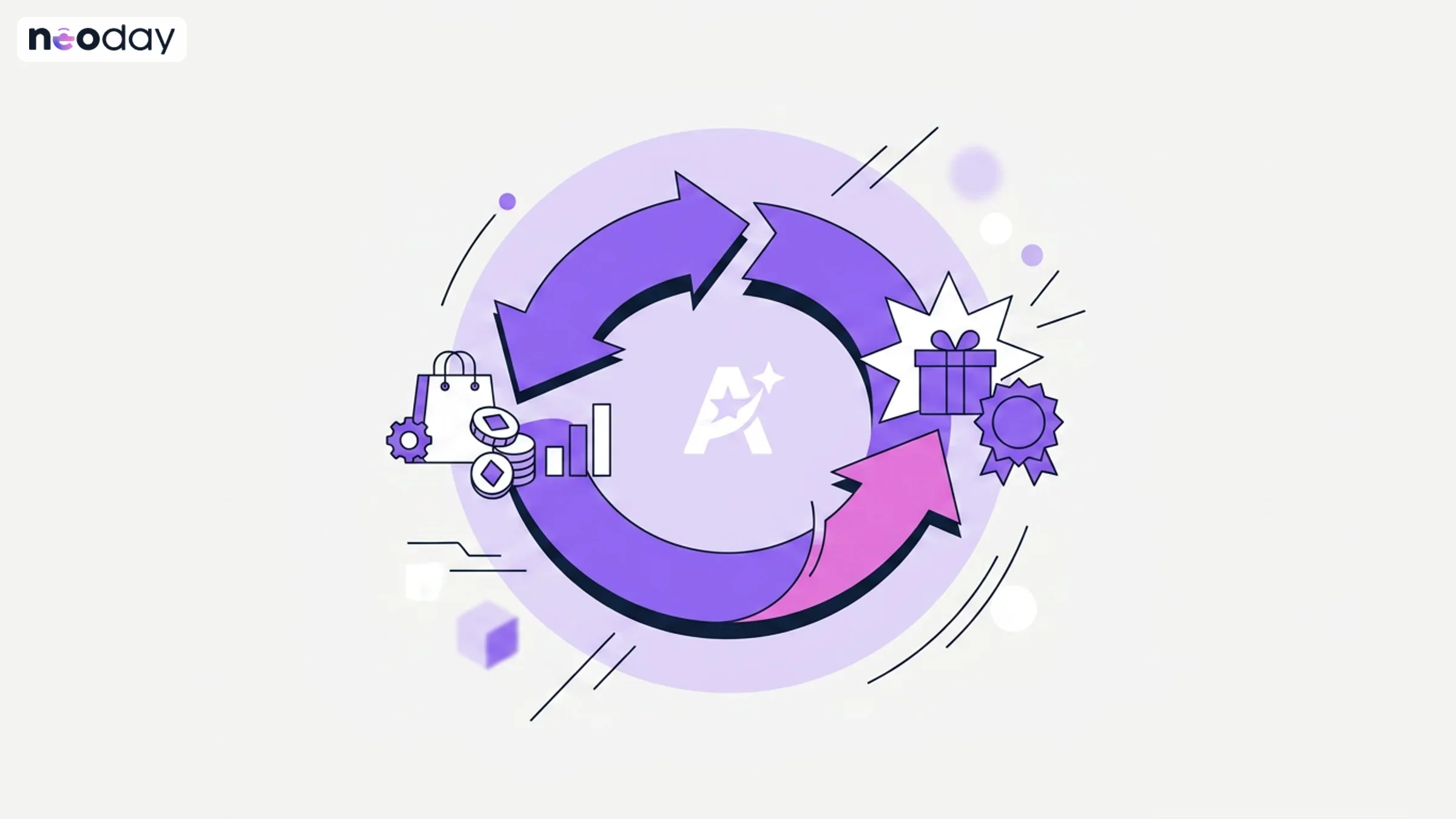
The earn-and-redeem cycle is the mechanical backbone of most loyalty programs, turning repeat purchases into tangible customer rewards.
The Key Components of a Loyalty Program
Regardless of structure, effective loyalty programs share a set of core components. The table below breaks these down.
Component | What It Does | Why It Matters |
|---|---|---|
Enrollment mechanism | Captures customer identity at sign-up | Enables tracking and personalization |
Earning rules | Defines what actions generate rewards | Shapes customer behavior |
Reward catalog | Lists what customers can redeem points for | Determines perceived program value |
Expiry and rules engine | Sets time limits and exclusions | Controls liability and margins |
Communication layer | Sends emails, push notifications, SMS | Keeps the program top of mind |
Analytics dashboard | Reports on participation and ROI | Guides program optimization |
Integration layer | Connects to POS, e-commerce, CRM | Makes data flow seamlessly |
Each component relies on the others. A program with a generous reward catalog but no communication layer will underperform because customers forget to use it. A program with great analytics but poor enrollment mechanics will have too little data to act on.
Why Businesses Invest in Loyalty Programs
The business case for loyalty programs centers on one core insight: retaining an existing customer costs significantly less than acquiring a new one. Research from Bain and Company suggests that a 5% increase in customer retention can increase profits by 25% to 95%, depending on the industry.
Loyalty programs support retention by giving customers a reason to return that is independent of any single transaction. Even if a competitor runs a promotional discount, a customer with accumulated points has a switching cost that holds them in place.
Beyond retention, loyalty programs generate first-party data. Every transaction linked to a loyalty account tells you who bought what, when, and how often. This data is enormously valuable for personalizing offers, forecasting demand, and identifying at-risk customers before they churn.
For a fuller picture of why retention matters at a strategic level, this guide on customer retention is worth reading before you design your program.
What Makes a Loyalty Program Effective?
Not every loyalty program delivers results. Many are launched with good intentions and quietly abandoned two years later because participation dropped off. The programs that work share several characteristics.
Simplicity. If a customer cannot explain how to earn and redeem rewards in one sentence, the program is too complicated. Complexity is the enemy of participation.
Relevant rewards. Free items, discounts, and experiences that customers actually want will outperform generic cashback every time, provided they align with what the business already offers.
Timely communication. Points balances that customers never see might as well not exist. Triggered messages (you are 50 points away from a reward) dramatically increase redemption rates and perceived program value.
Consistency. A loyalty program is a promise. Changing the terms without notice or quietly devaluing points destroys trust faster than any single bad service experience.
Data-driven iteration. The best programs treat launch as a starting point, not a finished product. Regular analysis of which rewards drive the most visits, which tiers retain customers best, and which segments are disengaging allows continuous improvement.
Loyalty Programs by Industry
The mechanics of loyalty programs adapt to the specific behavior patterns of each industry. The table below summarizes how the model shifts across three major sectors.
Industry | Typical Trigger | Common Reward | Key Metric |
|---|---|---|---|
Retail | Purchase amount (basket size) | Discount vouchers, free products | Repeat purchase rate |
Restaurant | Visit frequency | Free meal, drink upgrade | Visits per month |
Membership / Subscription | Ongoing subscription | Exclusive access, early releases | Churn rate |
Restaurants often prioritize visit frequency over spend because average check sizes are relatively fixed. Retail programs tend to focus on basket size and cross-category purchasing. Membership businesses use loyalty mechanics to reduce churn by layering additional perks on top of the core subscription.
If you want to see how leading brands apply these principles in practice, the articles on restaurant loyalty program examples and retail loyalty program examples offer detailed breakdowns across real-world cases.
Choosing the Right Loyalty Program Software
The software you choose determines how much of your program you can automate, how cleanly it integrates with your existing stack, and how much operational overhead you carry day to day.
Key questions to ask when evaluating platforms:
Does it integrate natively with your POS or e-commerce platform?
Can you configure earning rules and reward tiers without developer support?
Does it support multiple communication channels (email, SMS, push)?
How does it handle coupon and voucher issuance? For businesses that rely heavily on promotional offers, dedicated coupon software built into the loyalty platform removes the need for a separate tool.
What does the analytics layer actually show, and can you export the data?
For businesses exploring their options, the NeoDay loyalty platform is designed specifically for retail, restaurant, and membership use cases, with configurable program types and built-in communication tools.
Common Mistakes to Avoid
Even well-resourced businesses make predictable mistakes when launching loyalty programs.
Setting rewards too low. A program where customers need to spend thousands before earning anything meaningful will see low enrollment and even lower engagement. The perceived effort has to be proportionate to the perceived reward.
Ignoring the redemption experience. Earning points is motivating. Redeeming them has to be frictionless. If redemption requires a phone call or a specific staff member, customers will accumulate points they never use and eventually disengage.
Not communicating enough. Loyalty programs that launch with a sign-up email and then go silent lose momentum within weeks. A calendar of automated, behavior-triggered communications is not optional; it is the engine that keeps the program alive.
Treating all customers the same. High-value customers deserve different treatment than occasional visitors. Segmentation, whether through tiers or targeted offers, is what turns a transactional program into a relationship.
For examples of how businesses across different sectors have navigated these challenges, the loyalty program examples across industries article provides useful reference points.
Sources
Bain and Company. "Prescription for Cutting Costs." (Frederick Reichheld, 2001)
Bond Brand Loyalty. "The Loyalty Report" (2023 edition)
Accenture. "Making It Personal: Rules of Engagement for the Connected Consumer" (2017)
Harvard Business Review. "The Value of Keeping the Right Customers" (2014)
FAQ: What Is a Loyalty Program and How Does It Work?
What is a loyalty program? A loyalty program is a structured marketing strategy that rewards customers for repeated actions such as purchases, visits, or referrals. Businesses use loyalty programs to increase customer retention, generate first-party data, and encourage higher spending over time.
How does a loyalty program work? A loyalty program works by tracking customer behavior and converting qualifying actions into points, stamps, or credits. Customers accumulate these over time and redeem them for rewards such as discounts, free products, or exclusive access. The entire cycle is typically managed by loyalty software that automates tracking, reward issuance, and customer communication.
What are the main types of loyalty programs? The main types are points-based (earn-and-burn), tiered programs, paid membership programs, cashback programs, and coalition programs. Each type suits different business models and customer behavior patterns.
What is the difference between a loyalty program and a rewards program? The terms are often used interchangeably. In practice, a rewards program usually refers to the earning-and-redeeming mechanics, while a loyalty program is the broader strategy that includes those mechanics plus communication, data collection, and customer relationship management.
How do businesses measure the success of a loyalty program? Key metrics include repeat purchase rate, redemption rate, program enrollment rate, average order value among members versus non-members, and customer lifetime value. Churn rate among loyalty members compared to non-members is also a strong indicator of program effectiveness.
Are loyalty programs worth it for small businesses? Yes, provided the program is simple and the software cost is proportionate to the revenue opportunity. Small businesses often benefit most from stamp-card or basic points programs that require minimal operational overhead but still create a tangible reason for customers to return.
What rewards work best in a loyalty program? Rewards that are directly related to the business (free products, service upgrades, exclusive access) tend to outperform generic cashback for most retail and restaurant businesses. The best reward is one that customers genuinely want and that costs the business less than the incremental revenue it drives.
How do I start a loyalty program for my business? Start by defining the customer behavior you want to encourage (visits, spend, referrals). Then choose a program structure (points, tiers, membership), select software that integrates with your POS or e-commerce platform, set earning and redemption rules, and plan a communication strategy. Pilot with a subset of customers before a full rollout to validate the mechanics before scaling.