
Blog
Product Updates
Gamified Loyalty Programs: Boost Retail Visits and App Use

Ronald Meeuwissen

Retailers that add gamification to their loyalty programs report up to 47% higher member engagement and significant lifts in mobile app usage, repeat visits, and daily active users. The mechanic is not new, but the gap between retailers that use it well and those that bolt on a points system has widened.
Gamified loyalty programs turn routine transactions into a sequence of small, satisfying wins: a streak, a quest, a tier upgrade, a surprise reward. Done right, they convert a one-time discount-chaser into a member who opens your app five times a week. This guide breaks down what gamification in loyalty programs actually means, which mechanics drive which behaviors, how leading retailers structure their programs, and the framework for designing your own.
What Is a Gamified Loyalty Program?
A gamified loyalty program is a customer loyalty system that uses game design elements (points, missions, badges, levels, leaderboards, instant-win mechanics) to motivate repeat behavior beyond a simple "spend money, earn discount" transaction.
Traditional points programs reward one thing: spend. Gamified programs reward many things:
Repeat visits within a window
Trying new products or categories
Engaging with the app or content
Completing structured missions or challenges
Hitting status thresholds
Inviting friends
The shift matters because not every retail customer is price-driven. Some are motivated by status, novelty, social proof, or the simple satisfaction of completing a task. Gamification gives a program multiple levers to pull instead of one.
Why Gamification Works: The Behavioral Math
Gamification taps into well-documented psychological drivers. Three matter most for retail loyalty:
Variable rewards. A surprise drop, a mystery box, or an instant-win mechanic drives engagement harder than a fixed reward of the same value. This is the same loop that makes mobile games sticky.
Loss aversion and progress. When a customer is 80% of the way to a reward or tier, the pain of losing that progress motivates action far more than the equivalent absolute reward would.
Status and identity. Tiered systems work because reaching "Gold" or "Platinum" becomes part of how the customer sees themselves, not just what they get.
The numbers back the theory:
Metric | Impact of Gamification |
|---|---|
Member engagement lift | Up to 47% higher than non-gamified programs |
App opens per member | 2-3x higher in gamified vs transactional programs |
Daily active users (DAU) | 30-40% lift after gamification launch |
Repeat purchase rate | 22% higher among members completing missions vs members not |
Member-to-non-member spend ratio | 1.6-2.5x depending on tier and engagement |
The other reason retailers care: gamification is one of the few loyalty levers that lifts both frequency and basket size simultaneously, rather than trading one for the other.
The Core Gamification Mechanics for Retail
Not every mechanic fits every retailer. The choice depends on purchase frequency, app vs in-store mix, and the customer behavior you want to change.
Mechanic | What It Drives | Best Fit | Watch-Outs |
|---|---|---|---|
Points and tiers | Repeat spend, status progression | Mid-frequency retail, multi-category | Can feel transactional if used alone |
Missions and quests | Trying new categories, app engagement | Retailers with broad catalogs or app-first members | Requires regular new mission content |
Streaks | Visit frequency, app opens | High-frequency retail (grocery, beauty, QSR) | Resets feel punishing; design carefully |
Instant win and mystery boxes | App opens, surprise-and-delight | App-driven programs, seasonal pushes | Cost control on reward distribution |
Badges and achievements | Long-tail engagement, social sharing | Brand-led programs, lifestyle retail | Low impact alone, strong as a layer |
Leaderboards | Peer competition, top-tier engagement | Niche communities, ultra-loyal segments | Can feel cliquey for mass-market |
Challenges (time-bound) | Off-peak traffic, seasonal pushes | Any retailer, in-app and email | Needs strong promotion to drive entries |
The most effective gamified loyalty programs combine 3-4 mechanics layered on top of a points foundation. A single mechanic in isolation almost always underperforms a combined system.
For a broader view of how different industries layer these mechanics, see loyalty program examples across industries.
How Retailers Boost In-Store and Online Visits with Gamification
Visit frequency is the metric most affected by gamification. The mechanics that move it:
1. Time-Bound Missions Tied to Visit Windows
A mission like "Visit twice this week, earn 500 bonus points" converts a casual shopper into a repeat visitor by giving them a reason to come back inside a specific window. The constraint is what makes it work: an open-ended "visit more" never lands the same way as "by Sunday."
2. Streaks With Forgiveness Mechanics
A 7-day or 4-week streak counter creates a strong return-visit motivation. The best implementations include a one-time "streak shield" or grace period so a missed visit does not feel terminal and trigger churn. Brutally strict streaks can outperform short-term, but they have higher long-tail drop-off.
3. Tier-Up Nudges in Mobile
Sending a member a push notification along the lines of "2 more visits this month to reach Gold" is one of the highest-converting loyalty messages a retailer can send. The mechanic works because it leverages loss aversion (the customer is close enough to feel they can lose progress) and identity (Gold is the goal, not the reward).
4. Off-Peak Multipliers
Double points on Tuesday-Wednesday afternoons, or 3x points on the first visit of a slow week, redirect trips into hours retailers actually need filled. This is gamification working as an operational tool, not just a marketing one.
5. Surprise-and-Delight Drops in Store
When a member checks in or scans at the register, a small chance to trigger an instant win (free coffee, free dessert, 20% off the next visit) creates the variable-reward loop that makes app-opens and store visits feel exciting rather than transactional.
For more on how these tactics show up in practice, see best retail loyalty program examples.
How Retailers Boost App Usage with Gamification
App-based loyalty is where gamification's lift is largest. A non-gamified loyalty app gets opened when the member needs to redeem something. A well-gamified app gets opened daily.
App-Specific Mechanics
Daily check-in rewards. Open the app, get a small streak-based reward. Trivial individually, powerful in aggregate.
Progress bars on every screen. Showing how close the member is to the next reward, tier, or mission completion increases session length and return rate.
Mission center. A dedicated screen with 3-5 active missions and 2-3 upcoming ones gives members a reason to open the app even when they are not actively shopping.
Spin-to-win or mystery box features. Once-per-day mechanics that drive predictable app opens. Cost control comes from setting reward tier probabilities.
In-app exclusives. Rewards or content available only inside the app, never on web or email. This is the single biggest driver of app-first behavior.
The retailers seeing the biggest app DAU lifts from gamification typically share a pattern: the app is not just a digital loyalty card, it is the program itself. Web and email become the secondary surfaces.
A digital membership card that lives in the customer's wallet but pushes them back into the app on every scan is the bridge between in-store activity and app engagement.
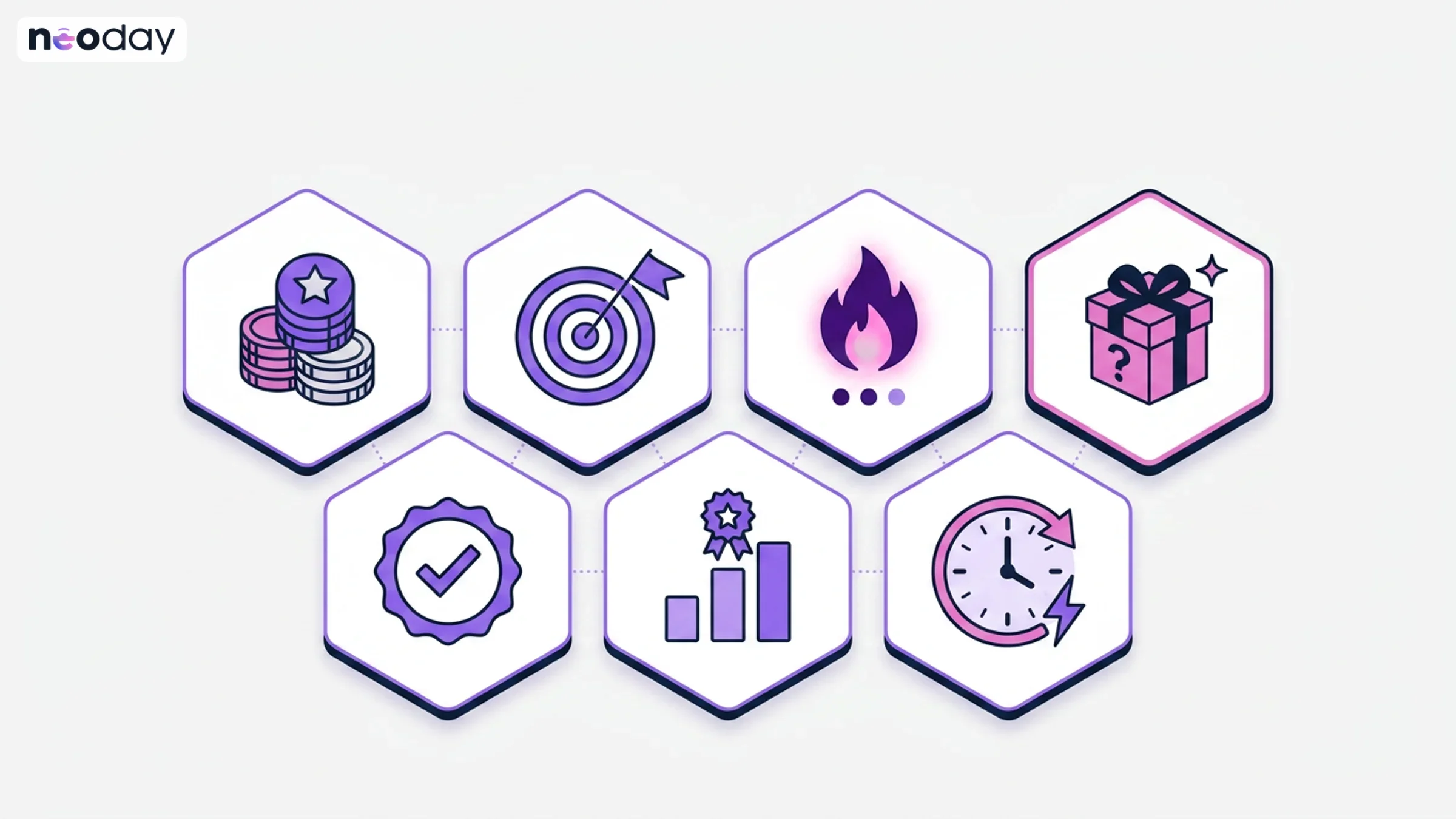
The seven core gamification mechanics retailers layer into loyalty programs. Most effective programs combine three to four of these on top of a points foundation.
Examples of Gamified Loyalty Programs That Work
Several retailers have made gamification the engine of their loyalty program rather than a feature on the side:
Starbucks Rewards. Time-bound double-star challenges, streak-based promotions, and personalized missions delivered through the app have made Starbucks Rewards one of the most-studied gamified programs in retail. The app is where the program lives.
Sephora Beauty Insider. A tiered structure (Insider, VIB, Rouge) layered with point-based redemption, exclusive events, and birthday rewards combines status, points, and surprise into a single program.
Nike Membership. Mission-based engagement, badges for completed activities, exclusive product drops, and access to limited releases make the program feel like a club, not a discount card.
Lego Insiders. Points (called VIP points) combined with tier-based rewards, exclusive sets, and member-only events drive both repeat purchase and emotional engagement with the brand.
Decathlon Members. Mission-based rewards tied to sports practice, gamified challenges, and tier progression turn a price-led retailer into a community-led one.
The common thread: in each case, the program is not "earn points, get a discount." It is a series of structured behaviors with multiple reward paths.
How to Design a Gamified Loyalty Program: A 6-Step Framework
The framework below is what most successful retailer programs follow, even if the steps are not labeled this way internally.
Step 1: Define the Behavior You Want, Not the Reward
Start with the answer to: "If members did one more thing every month, what would it be?" Examples:
Open the app 3x more often
Try a new product category
Visit during off-peak hours
Refer a friend
Engage with content (reviews, social shares)
The mechanic and reward are downstream of this. Programs that start with rewards and back into behavior almost always end up paying out for activity that would have happened anyway.
Step 2: Choose Your Mechanic Mix
Based on the target behavior:
If You Want To Drive... | Lead With |
|---|---|
Visit frequency | Streaks + time-bound missions + tier nudges |
Category expansion | Quest chains + first-purchase bonuses |
App engagement | Daily check-in + mission center + in-app exclusives |
Repeat in-app purchases | Tiered points + instant win on check-out |
Off-peak traffic | Time-windowed multipliers + challenges |
Word-of-mouth | Referral missions + social badges |
Use one primary mechanic and 2-3 supporting ones. Avoid stuffing every mechanic into a launch.
Step 3: Design the Reward Economy
The single biggest mistake retailers make is over-rewarding gamification activity. The discipline:
Total program cost should land in 3-5% of member revenue for most retailers
Surprise-and-delight rewards should be low-cost-high-perceived-value (a free coffee, not a free TV)
Tiered rewards should make members feel the climb is worth it without bankrupting margin
Use variable reward distributions, not flat ones. A small chance of a high reward beats a guaranteed small reward at the same expected value
Step 4: Build the Loop, Not Just the Launch
A gamified loyalty program is not a one-time campaign. It is a content engine. You need a cadence of:
New missions every 2-4 weeks
Seasonal challenges 4-6x per year
Special drops or instant-win events 1-2x per month
Tier-up communication automated for every member who reaches 80% of the next threshold
Programs that launch and never refresh see engagement decay in 60-90 days. Plan the loop before launch, not after.
Step 5: Wire Up the Tech Stack
A working gamified retail loyalty program needs:
A loyalty platform that supports more than just points (missions, tiers, instant-win mechanics)
POS integration to track in-store activity in real time
A mobile app or wallet pass for the customer-facing experience
Lifecycle messaging (push, SMS, email) tied to loyalty state
Reporting on mechanic-by-mechanic engagement and ROI
NeoDay's loyalty platform supports points, tiers, missions, and coupon-based campaigns alongside digital membership cards, which lets retailers run a layered program without building the engine in-house. The coupon software handles the time-bound and surprise-and-delight side of the gamification mix.
Step 6: Measure and Iterate
The metrics that tell you whether gamification is actually working:
Engagement rate per mechanic. Mission completion rate, streak length distribution, instant-win participation
App DAU and session length. The leading indicator of program health
Member-vs-non-member spend lift. The number that justifies the program to finance
Tier distribution and progression. Are members climbing, or stuck?
Redemption rate. Members who redeem are 2-3x more likely to become long-term loyal
Run quarterly reviews on mechanic-by-mechanic ROI. Underperforming mechanics should be retired or replaced, not left in place to clutter the experience.
Common Pitfalls That Kill Gamified Loyalty Programs
The failure modes are well-known and avoidable:
Over-rewarding. Members get used to the reward level, and the program becomes a fixed cost without a behavior change.
Mechanic overload at launch. Too many mechanics confuse members and dilute attention. Start with a tight set and expand.
No content refresh. The first 60 days look great, then mission completion craters because nothing new ships.
App not integrated with in-store. If a member visits a store and the visit does not register in the app, the loop breaks.
Tier benefits too thin. Reaching Gold and unlocking a 5% discount is not worth the climb. Top tiers need real benefits, not symbolic ones.
Ignoring the bottom tier. Most members live in Bronze. If Bronze has nothing interesting, the program never gets out of the entry funnel.
How Gamification Connects to Customer Retention
Gamified loyalty is one of the strongest tools available for retail customer retention because it gives members reasons to return that are independent of any individual transaction. The deeper connection between mechanic and behavior is what turns a 6-month loyalty member into a 5-year one. For a broader view of why this matters for the business overall, see why customer retention matters.
Key Takeaways
Gamification is a system of layered mechanics, not a single feature. The best retail programs combine 3-4 mechanics on a points foundation, each driving a different behavior.
Start with the behavior, not the reward. The reward and the mechanic are downstream of the behavior change you want.
Build for the loop, not the launch. New missions, seasonal challenges, and tier-up nudges need a content cadence from day one.
Variable rewards beat fixed rewards at equivalent cost. Mystery boxes, instant win, and surprise drops outperform guaranteed payouts.
App is the primary surface for gamified loyalty. In-app exclusives, daily check-ins, and mission centers are the single biggest drivers of daily active users.
Sources: Antavo Global Customer Loyalty Report, LoyaltyLion Loyalty Statistics, Queue-it Loyalty Program Statistics, Smile.io Gamification Research, Starbucks, Sephora, Nike, Lego, and Decathlon public program documentation
FAQ
What is a gamified loyalty program? A gamified loyalty program is a customer loyalty system that uses game-design elements like points, missions, badges, streaks, tiers, and instant-win mechanics to motivate repeat behavior beyond a simple spend-to-discount transaction. Members are rewarded for a wide range of actions, including app opens, category trials, and visit streaks, not just for spending money.
How does gamification in loyalty programs work? Gamification works by adding structured, behavior-based rewards on top of a points foundation. Members complete missions, hit streaks, reach tiers, or trigger surprise rewards, and the program tracks each action and pays out accordingly. Done well, the result is higher visit frequency, deeper app engagement, and stronger emotional attachment to the brand than transactional loyalty alone produces.
What are the best gamification mechanics for retail loyalty? The mechanics that work best for retail are: points and tiers (foundation), missions and quests (drive category and behavior changes), streaks (drive visit frequency), instant-win and mystery boxes (drive app opens), and challenges (drive off-peak traffic). Most retailers layer three to four of these together rather than relying on any single mechanic.
How do gamified loyalty programs increase app usage? Gamified programs use daily check-in rewards, mission centers, in-app exclusives, progress bars, and instant-win mechanics to give members a reason to open the app even when they are not actively shopping. Retailers that build the entire program around the app, rather than treating the app as a secondary surface, typically see 2-3x higher app open rates than traditional loyalty apps.
Does gamification really increase customer spend? Yes, when designed well. Industry data shows gamified loyalty programs drive 22% higher repeat purchase rates and 1.6-2.5x higher member-to-non-member spend ratios. The key is that gamification lifts both frequency and basket size at the same time, rather than trading one for the other the way pure discount programs often do.
How long does it take to launch a gamified loyalty program? For most retailers, 8-12 weeks from decision to launch. The work splits into platform setup and POS integration, mechanic design and reward economy modeling, app or mobile experience build, and a staged rollout. Larger multi-brand or multi-region programs typically take 4-6 months because of the integration and content planning scale.
How is a gamified loyalty program different from a points program? A points program rewards one behavior: spend. A gamified loyalty program rewards many: visits, missions, streaks, app opens, referrals, category trials, and tier progression. Points are usually one mechanic inside a gamified program, but the program as a whole gives the retailer many more levers to pull and the member many more reasons to engage.
What metrics should I track for a gamified loyalty program? Track engagement rate per mechanic (mission completion, streak length, instant-win participation), app daily active users and session length, member-vs-non-member spend lift, tier distribution and progression, and redemption rate. Engagement metrics tell you whether mechanics are working. Spend lift tells you whether the program is paying for itself.