
Blog
Product Updates
Points vs Missions vs Instant Win: Which Loyalty Mechanic Works Best in Retail

Jurgen Swaans

Choosing the right loyalty program mechanics in retail is one of the most consequential decisions a brand can make when building a rewards strategy. Points systems, mission-based challenges, and instant win promotions each create a different emotional contract with your customer. Pick the wrong one for your context and you waste budget; pick the right one and you accelerate both repeat visits and average order value.
This post breaks down how each mechanic works, where each one wins, and how to decide which fits your retail, restaurant, or membership business today.
What loyalty program mechanics actually are
Loyalty program mechanics are the rules and reward structures that determine how customers earn value and what motivates them to come back. They are the engine inside any loyalty program, separate from the interface, the branding, or the reward catalog.
Three mechanics dominate retail loyalty right now: points accumulation, mission or challenge completion, and instant win or scratch-card formats. Each taps a different psychological driver. Understanding that psychology is the starting point for any operator who wants to build a program that performs rather than just exists.
Points: the workhorse of retail loyalty
Points-based loyalty is the oldest and most widely deployed mechanic in retail. Customers earn points per transaction, per dollar spent, or for specific behaviors (writing a review, referring a friend), then redeem those points for discounts, free products, or exclusive access.
The appeal is clarity. Customers understand the relationship between spending and earning, which reduces friction during sign-up and keeps engagement passive. You do not need to ask customers to change their behavior dramatically; you reward them for what they already do.
Points also create a psychological phenomenon known as loss aversion. Once a customer has accumulated 400 points toward a 500-point reward, the sunk-cost feeling of abandoning those points is a powerful retention lever. This is why points programs consistently outperform no-program baselines on repeat purchase rates.
The downside is commoditization. When every retailer in a category runs a points program, none of them stand out. Points can also become a liability on the balance sheet if redemption rates rise unexpectedly, and they reward high spenders while offering little to customers who visit frequently but spend modestly.
Best fit for points: high-frequency, moderate-basket retailers such as grocery, pharmacy, and fast-casual dining, where volume makes the math work and passive accumulation suits busy customers.
For a practical look at how leading retailers deploy points, see best retail loyalty program examples.
Missions: turning loyalty into a game
Mission-based loyalty (sometimes called challenge mechanics or quest mechanics) asks customers to complete a defined set of actions to unlock a reward. Buy coffee three days in a row. Visit on a Tuesday. Try two new menu items this month. Complete all five actions and earn a premium reward.
Missions borrow directly from game design. The progress bar, the defined endpoint, the sense of narrative completion all trigger a dopamine loop that points programs rarely achieve. Customers who engage with missions show higher emotional attachment to the brand, not just transactional loyalty.
Missions also give operators a targeting tool. You can design a mission to drive a specific behavior: introduce customers to a new product category, increase lunchtime traffic, boost subscription sign-ups. That precision is something a passive points program cannot easily replicate.
The complexity cost is real. Missions require more creative effort to design, more communication to explain, and more technical infrastructure to track. If a mission feels arbitrary or too difficult, it damages trust rather than building it. Missions also have a natural expiry, which means operators must refresh them regularly to maintain engagement.
Best fit for missions: brands with a story to tell or a behavior to shape, including specialty retail, subscription boxes, and restaurant chains launching seasonal menus. If you want customers to explore rather than just repeat, missions are the mechanic.
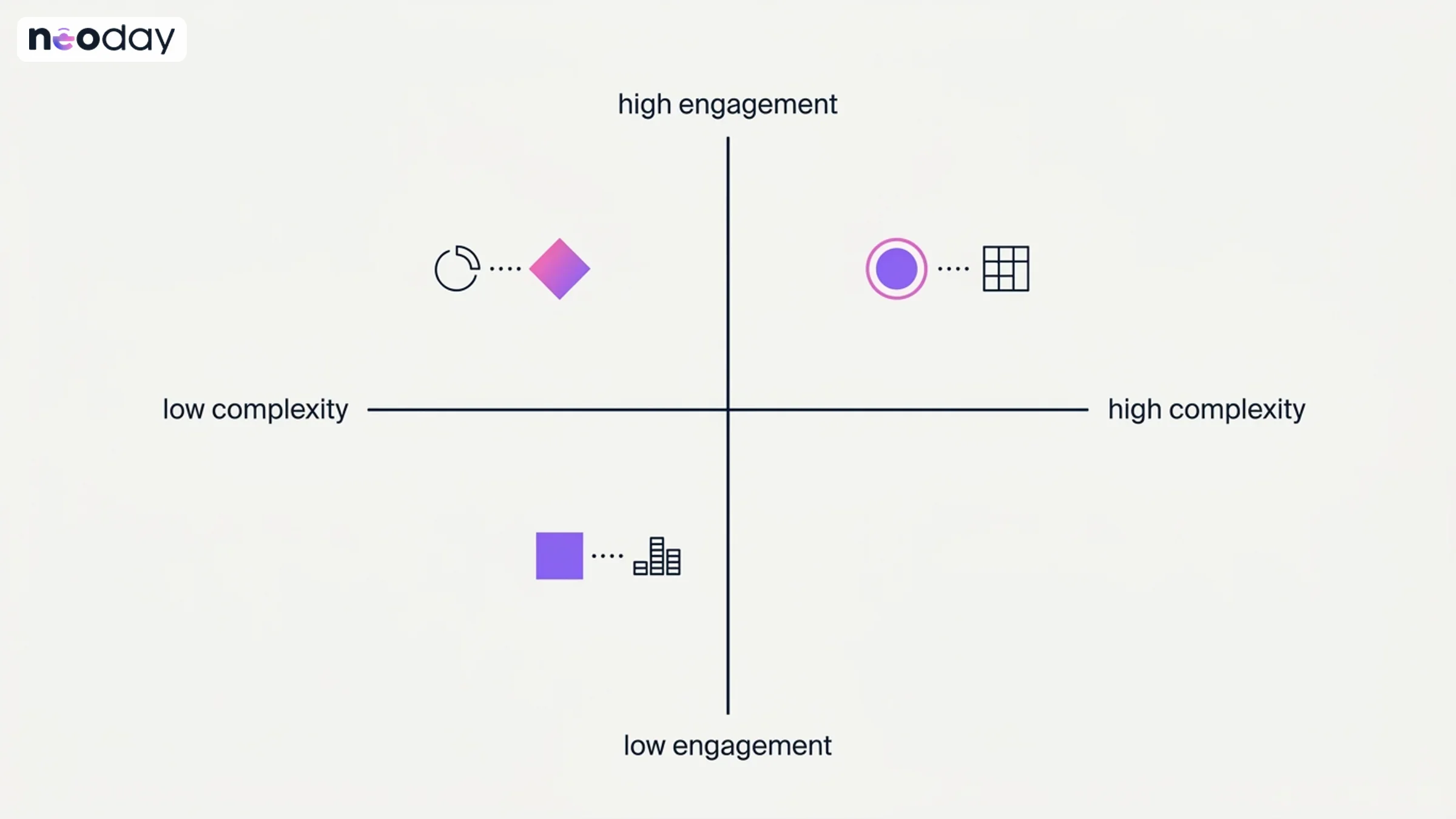
Mapping each mechanic by engagement intensity and operational complexity helps retailers choose the right starting point before building their program.
Instant win: urgency, surprise, and the spike
Instant win mechanics include digital scratch cards, spin-to-win wheels, and random reward draws triggered by a purchase or visit. The customer takes an action and immediately discovers whether they have won a prize, a discount, or nothing. The outcome is immediate and the uncertainty is the point.
Instant win programs are built on variable reward psychology, the same principle that makes slot machines compelling. Unpredictable rewards are more motivating in the short term than predictable ones. A 1-in-10 chance of winning a significant prize can drive more trial behavior than a guaranteed 10% discount of equivalent expected value.
For retail, this makes instant win a powerful acquisition and reactivation tool. New customers who would not bother collecting points over weeks will pull a digital scratch card today. Lapsed customers respond to "you have a scratch card waiting" notifications at far higher rates than generic re-engagement emails.
The risk is dependency. Customers who come back only for the game stop coming back when the game ends. Instant win mechanics rarely build the durable habit that points or missions create. Run them as a permanent program feature and you erode margin; run them as a time-limited activation and they become a reliable spike driver.
Best fit for instant win: product launches, seasonal promotions, new location openings, and reactivation campaigns. They work best as a layer on top of an existing loyalty structure rather than as the primary mechanic.
Comparing the three mechanics side by side
The table below summarizes how each mechanic performs across key dimensions that matter to retail operators.
Dimension | Points | Missions | Instant Win |
|---|---|---|---|
Customer effort to engage | Low (passive) | Medium (active) | Very low (one tap) |
Emotional engagement | Moderate | High | High (short-lived) |
Behavior shaping ability | Low | High | Low |
Setup complexity | Low | High | Medium |
Retention impact | High (long-term) | High (medium-term) | Low (short-term) |
Acquisition / trial driver | Low | Low | High |
Balance sheet liability risk | Medium-High | Low | Low-Medium |
Best deployment mode | Core program | Ongoing layer | Campaign activation |
No single mechanic wins on every dimension. The strongest programs combine them, using points as the persistent backbone, missions to drive specific behaviors, and instant win to create campaign moments.
How to choose the right mechanic for your retail context
Before committing to a mechanic, answer three questions about your business.
First: what is your visit frequency? High-frequency categories (coffee, grocery, quick-service restaurants) support points programs because customers accumulate value quickly enough to feel motivated. Low-frequency categories (furniture, electronics, luxury) are better served by missions that reward exploration and relationship depth rather than repeat purchase speed.
Second: what behavior do you most need to change? If your problem is average basket size, a points multiplier on underperforming categories addresses it directly. If your problem is that customers know only one part of your assortment, a mission that rewards cross-category discovery is more precise. If your problem is that you have a large lapsed segment, instant win reactivation is likely the fastest lever.
Third: what is your operational capacity? A solo-operator boutique and a 200-location chain have very different capacities to design, communicate, and refresh missions. Honest assessment of your team's bandwidth prevents you from launching a mechanic you cannot sustain.
For a broader view of how loyalty mechanics translate across categories beyond retail, loyalty program examples in various industries provides useful context.
If you are building for a restaurant context specifically, best restaurant loyalty program examples covers how leading chains have combined these mechanics in practice.
The role of software in making mechanics work
Mechanics do not operate in isolation. They depend entirely on the software infrastructure beneath them: how points are tracked, how missions are defined and monitored, how instant win outcomes are generated and validated.
A loyalty platform built for retail needs to support all three mechanics without requiring a different tool for each. It should allow operators to stack mechanics, run A/B tests between reward structures, and connect loyalty behavior to purchase data without manual exports.
NeoDay is built for exactly this use case. The NeoDay loyalty platform lets retail, restaurant, and membership operators configure points, challenges, and promotional mechanics within a single system. For operators who rely heavily on coupon-based rewards as part of their instant win or points redemption flow, NeoDay's coupon software handles issuance, validation, and fraud prevention natively. Membership businesses looking to anchor loyalty in a card-based identity layer can explore membership card software as the foundation.
The right software removes the operational friction that causes operators to default to whichever mechanic is easiest rather than whichever one fits best.
A framework for stacking mechanics over time
The most durable loyalty programs do not choose one mechanic; they layer them deliberately as the customer relationship matures.
Customer lifecycle stage | Recommended primary mechanic | Supporting mechanic |
|---|---|---|
Acquisition (first 1-2 visits) | Instant win (low friction, high excitement) | Welcome points bonus |
Activation (visits 3-10) | Points (build habit, accumulate toward first redemption) | Onboarding mission |
Engagement (regular customer) | Points (passive, rewarding loyalty) | Rotating missions |
Growth (increase basket or frequency) | Missions (targeted behavior change) | Bonus points multipliers |
Reactivation (lapsed 60+ days) | Instant win ("you have a reward waiting") | Reactivation points offer |
This lifecycle approach means you are always using the mechanic that fits the customer's current relationship with your brand. It also prevents the mistake of treating loyalty as a single static program rather than a dynamic system.
Understanding why any of this investment pays off comes back to fundamentals. Customer retention: what it is and why it matters explains the financial case for loyalty investment that justifies the complexity of running multiple mechanics.
What the data says about mechanic performance
Across NeoDay program data and published retail loyalty research, a few patterns hold consistently.
Points programs reliably produce a 15 to 30 percent lift in repeat purchase rate versus no-program baselines, but the marginal difference between a well-designed and a poorly-designed points program is small. The mechanic is forgiving.
Mission-based programs show higher variance. A well-designed mission with a meaningful reward and clear communication can produce 40 to 60 percent engagement rates among active members. A poorly-explained or arbitrary mission sees single-digit completion. The mechanic rewards craft.
Instant win campaigns generate open rates two to three times higher than standard promotional emails when sent to lapsed segments, but the incremental revenue per reactivated customer is typically 20 to 30 percent lower than a customer retained through points or missions. The mechanic is efficient at volume, not depth.
The takeaway is not that one mechanic is superior. It is that each one has a predictable performance profile, and operators who understand those profiles can make deliberate choices rather than defaulting to whatever their competitor does.
Sources: Bond Brand Loyalty, The Loyalty Report 2024; Antavo Global Customer Loyalty Report 2024; McKinsey & Company, "The value of getting personalization right," 2021; NeoDay platform analytics (aggregated, anonymized).
FAQ: loyalty program mechanics in retail
What are loyalty program mechanics in retail? Loyalty program mechanics are the rules and reward structures that determine how customers earn and redeem value in a retail loyalty program. The three most common mechanics are points accumulation, mission or challenge completion, and instant win promotions.
Which loyalty mechanic is best for customer retention? Points-based mechanics produce the most consistent long-term retention because they reward habitual behavior passively and create loss aversion around accumulated balances. Missions add retention value when designed around recurring behaviors rather than one-time events.
When should a retailer use instant win mechanics? Instant win mechanics are most effective for acquisition campaigns, new product launches, seasonal promotions, and reactivating lapsed customers. They are less effective as a standalone retention tool because the engagement they generate is short-lived once the novelty fades.
Can a loyalty program use more than one mechanic at the same time? Yes, and most high-performing programs do. A common approach is to use points as the core persistent mechanic, layer missions on top to drive specific behaviors, and deploy instant win formats as time-limited campaign activations.
What is a mission-based loyalty program? A mission-based loyalty program asks customers to complete a defined set of actions within a time period to unlock a reward. Examples include visiting on three consecutive days, purchasing from two different product categories, or completing a new-member onboarding checklist. The mechanic borrows from game design to drive active engagement.
How do points programs create a balance sheet liability? Every unredeemed point represents a future obligation to deliver a discount or reward. If redemption rates rise, the cost of fulfilling that obligation increases. Retailers mitigate this through expiry policies, redemption thresholds, and by designing reward catalogs that favor high-margin items.
How does loyalty software affect which mechanics a retailer can use? Loyalty software determines which mechanics are operationally feasible. Platforms that only support points accumulation cannot run missions or instant win campaigns without custom development. Retailers looking for flexibility should choose software that supports multiple mechanic types natively, such as NeoDay.
What is the difference between points and a cashback loyalty program? Points programs express rewards in an abstract currency that must be redeemed through the program's reward catalog, which gives operators control over redemption cost and behavior. Cashback programs return a direct monetary value, which is simpler to communicate but offers less flexibility to shape customer behavior or manage reward economics.