
Increase customer lifetime value with loyalty that changes behaviour
More visits, a bigger basket and a longer relationship: the three levers of CLV, each with its own mechanic, measured against a control group.




What is customer lifetime value?
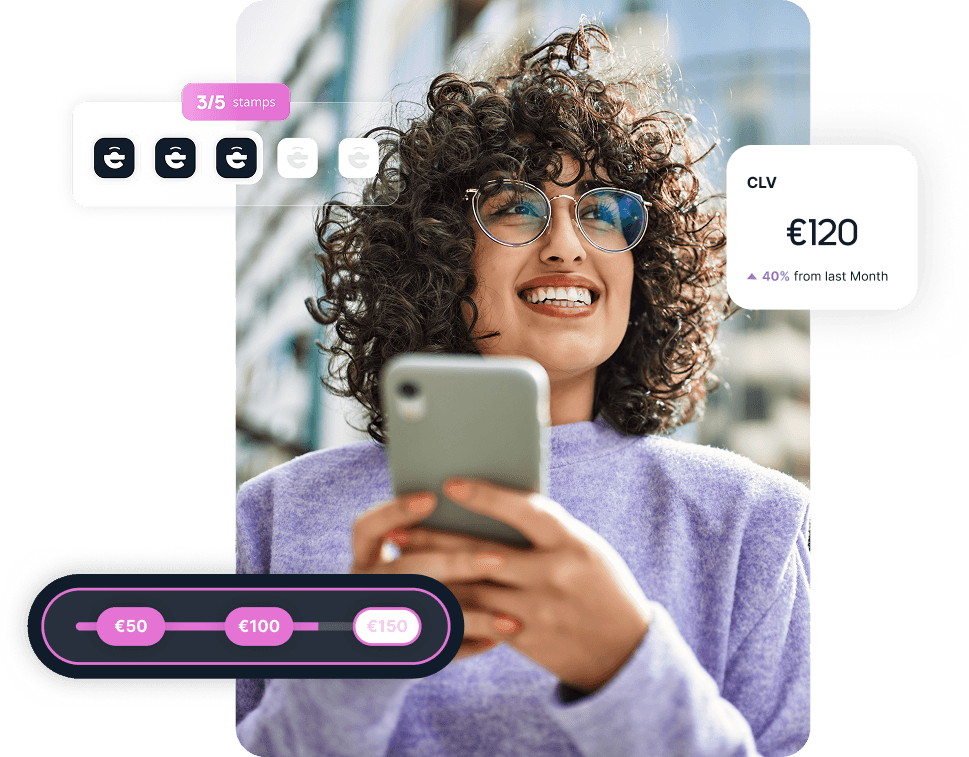
Customer lifetime value (CLV) is the margin a customer brings in over the whole relationship. A loyalty program raises it through three levers: more visits, a bigger basket and a longer relationship. NeoDay gives each lever its own mechanic, sized per member by NeoD.ai, and measures the uplift against a control group so finance can trust the number.
Always on margin, after reward cost. More in our guide to customer lifetime value.
How to calculate customer lifetime value in retail
CLV = average basket × visits per year × gross margin × years as a customer. For a finance-grade number, discount future years and weigh each year by the share of customers still active.
What small changes do to it (navy: today, pink: what the program adds)
Illustrative numbers.
The levers multiply. A longer relationship adds the most, but it takes the longest to prove. Build the business case on visits and basket, measured per campaign, and treat retention as the upside.
Three levers that raise CLV, and the mechanics behind each
Each lever needs its own reason for the member to act.
Visit frequency
A reason to come back this week.
Basket size and mix
A personal target per visit or month.
Relationship length
Status and value you do not want to lose.
How NeoDay increases CLV: four rhythms on one AI foundation
Every member gets a reason to come back at every time scale. NeoD.ai sets the target, the products and the timing per member, and spots members who start to drift before they are gone.
Points and tiers
Identity and a status worth protecting. This is the layer that keeps members from drifting away.
Personal milestones
A spend target sized on the member's own history. A member who spends €280 a month gets a €320 target, with rewards at 50%, 80% and 100% of the way.
Challenges
Short goals that lift frequency and get members to try new categories. Brands can fund them.
Games
A small reason to open the app tomorrow, so the program stays in the member's routine.
How to measure CLV uplift so your CFO believes it
- Hold out a random group. Often 10% of members get no campaign. They are your baseline.
- Compare treated with held out, not members with non-members, and count the incremental margin minus reward cost.
- Watch the leading indicators. Activation, the second visit and the first redemption move months before CLV itself can be measured. Our retention analytics track them per campaign.
CLV results from brands on NeoDay
Each result moves one of the levers. Campaign results are measured among participants.
La Place
Visits and reactivationIn one 41-day campaign, participants visited 52% more often and spent 20% more. 11,140 lapsed members came back.
Pathé
Members and visitsMore than 300,000 new members and 18% higher visit frequency.
Texaco
Activation80% more active users and a 35% redemption rate, with loyalty built into the existing app.
Heineken
Buying more400,000 active users, of whom 15% bought more.
Frequently asked questions
What is customer lifetime value?
CLV is the total margin a customer brings in over the full relationship with your brand. For retailers it combines how often someone visits, what they spend per visit, your margin and how long they stay. Calculate it on margin, after reward cost, not on revenue.
How do you calculate CLV for a retailer?
Multiply average basket by visits per year, by gross margin, by the expected number of years as a customer. A shopper with a €32 basket, 40 visits a year, 25% margin and 3 years is worth €960. Finance teams also discount future years and weigh them by the share of customers still active.
How does a loyalty program increase customer lifetime value?
It gives members a reason to visit more often, a personal target that lifts spend per visit, and status or rewards they do not want to lose. Each lever needs its own mechanic. One generic points scheme rarely moves all three.
Which loyalty mechanics have the most effect on CLV?
Challenges and stamp cards drive visit frequency. Personal milestones and basket thresholds drive spend per visit. Tiers and a visible reward shop keep members longer. Sizing targets from each member's own history is what makes them work for light and heavy shoppers alike.
How quickly does a loyalty program improve CLV?
Frequency and basket effects show up per campaign, within weeks: La Place's campaign ran for 41 days. Retention effects take a year or more to prove. NeoDay programs can launch in as little as 10 weeks.
How do you prove a loyalty program increased CLV?
Compare members who got a campaign with a random holdout group that got nothing, then count the incremental margin minus reward cost. Comparing members with non-members overstates the effect, because your best customers join first.