
Blog
Product Updates
Fuel loyalty programs: win the shop, not just the litre

Ronald Meeuwissen

Fuel is a commodity. Drivers choose a station on price, route and habit, and a few cents of discount per litre rarely changes that habit for long. The margin sits elsewhere: in the coffee, the sandwich, the car wash and the shop. A good fuel loyalty program (or programme, as many of our European clients write it) is built to move drivers from the pump to those places.
This short guide covers the three things that make fuel loyalty work: card linking, so every fill-up counts without friction; supplier co-funding, so rewards do not eat your fuel margin; and challenges that turn a fuel stop into a shop, car wash or food visit.
Why points per litre are not enough
Most fuel programs started as a card that earns points per litre. That still has a place: it gives drivers a reason to stay with your network and gives you an identity at the pump. But on its own it has two problems:
It rewards what drivers would do anyway. A commuter who fills up at the same station every week earns points for a habit you already had.
It is expensive. Rewards paid out of fuel margin are paid out of the thinnest margin in the business.
The fuel retailers we work with use points as the base and put the real effort into what happens after the pump.
Card linking: make every visit count
Drivers will not open an app at the pump if it slows them down. The program has to recognise them in the way they already pay and identify themselves:
App with a scan code for drivers who use your app, ideally inside the app they already have.
A physical loyalty card linked to the app account, so drivers who prefer a card still earn on the same account. In NeoDay, a physical card can be linked to each member's account.
Payment card linking, where a purchase is recognised from the payment itself. This depends on your payment provider and acquirer, so scope it with them early.
Whichever route you choose, the rule is one member ID for everything: fuel, shop, food and car wash. Without it, you cannot see that a fuel-only driver has started buying coffee, and you cannot reward it.
Supplier co-funding: let brands pay for the reward
Your shop sells products from drinks, snacks, coffee and car care brands that want trial and repeat purchase. A brand-funded challenge lets them pay for the reward: "buy this energy drink three times this month and get one free", funded by the brand, run in your app.
This changes the economics of the program:
Reward type | Who pays | Good for |
|---|---|---|
Points per litre | You, from fuel margin | Network loyalty, identity |
Shop and food challenges | You, from shop margin | Visit frequency, basket |
Brand-funded challenges | The supplier | Trial, new products, category growth |
Car wash upsell | You, from wash margin | The highest-margin add-on |
In NeoDay, brand-funded challenges are one of the weekly challenge types, alongside personalized, cross-category and trial challenges (layered approach). Agree up front how results are reported back to suppliers, because that report is what makes them fund the next campaign.
Upsell: from pump to shop, car wash and food
The challenges that pay off in fuel are the ones that move the driver one step further:
Pump to shop: "fill up twice this week and get a free coffee".
Pump to car wash: a wash milestone, or a free wash after a number of fuel visits.
Shop to food: a breakfast or lunch challenge for drivers who already buy coffee.
Daily games such as scratch cards in the app, to keep drivers opening it between fill-ups.
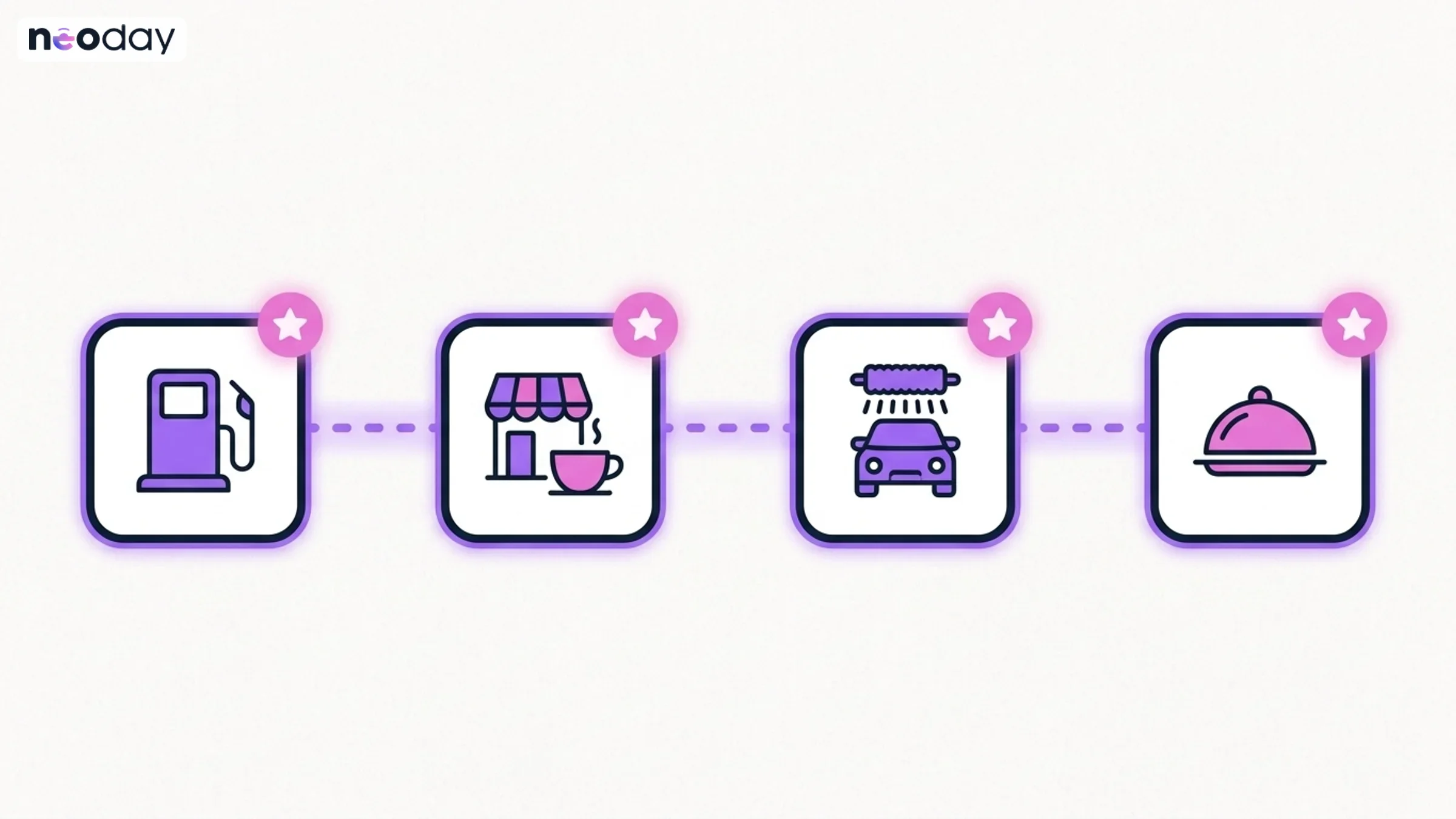
The value in fuel loyalty sits after the pump: the shop, the car wash and the food counter.
Texaco took this route with NeoDay, adding loyalty to its existing app through the NeoDay SDK. The result: +80% active users, +18% visit frequency and 35% redemption (Texaco case). MOL also runs its fuel loyalty campaigns on NeoDay.
How fast can a fuel loyalty program launch?
With NeoDay, a fully operational program can launch in as little as 10 weeks: inside your existing app through the SDK, as a standalone app in your brand, or on the web. The till integration is usually the critical path, so start that conversation in week one. Our launch timeline guide shows how the ten weeks are planned.
More on fuel: see our page for petrol stations and the car wash upsell. To see what a program could return for your network, calculate your business case or get a demo.
FAQ
What is a fuel loyalty program?
A fuel loyalty program rewards drivers for buying fuel and, more importantly, for using the shop, car wash and food offer at the station. Modern programs run in an app and combine points with challenges and games.
How do fuel retailers make loyalty profitable?
By moving rewards away from fuel margin. Points per litre keep drivers in the network, while challenges in the shop, car wash and food offer drive extra spend at better margins. Brand-funded challenges let suppliers pay for part of the rewards.
What is card linking in fuel loyalty?
Card linking connects a card the driver already uses to their loyalty account, so purchases count without extra steps. That can be a physical loyalty card linked to the app account or, depending on your payment provider, a payment card.
Can loyalty run inside our existing fuel app?
Yes. With the NeoDay SDK, loyalty screens, challenges and games appear inside your existing app. Texaco used this route and saw +80% active users.