
Blog
Product Updates
Gamified loyalty: personalized challenges and branded rewards

Jurgen Swaans

Most loyalty games disappoint for one simple reason: every member gets the same one. A spin-the-wheel that hands the same 5% coupon to a weekly shopper and to someone who visits twice a year feels like a lottery ticket, not a reason to come back. Gamified loyalty starts to pay off when the challenge is cut to the member: their categories, their visit rhythm, their next realistic step.
This article is for marketers who run a loyalty program for a brand with stores and want to move from generic games to personalized challenges. We cover how to customize missions per member, how to brand the reward screens so a win feels like your brand and not like a vendor template, and what to ask a gamified loyalty platform before you sign. We use the way we run this at NeoDay as the worked example, because it is what we know best.
What gamified loyalty with personalized challenges means
A gamified loyalty program uses game mechanics (progress, goals, chance, rewards with a moment of surprise) to change what members do. Two families of mechanics do very different jobs, and it helps to keep them apart:
Games such as scratch cards, spin the wheel, shake and win or a reward calendar give members a reason to open the app today.
Challenges (also called missions) ask for a behavior over days or weeks: visit three times this week, try the bakery, spend a little more than usual this month.
A personalized challenge is a challenge where the target, the products and the timing are set per member, based on what that member actually does. One member gets "two visits this week", another gets "try our own-brand coffee", a third gets nothing this week because the right moment for them is next week.
Mechanic | Rhythm | What it drives | Personalization lever |
|---|---|---|---|
Instant games (scratch, spin, shake) | Daily | Opening the app | Who gets a play, and what they can win |
Frequency challenge | Weekly | Visit frequency | Number of visits, set against the member's own baseline |
Cross-category or trial challenge | Weekly or seasonal | New categories, own brand | Which category or product |
Spend milestone | Monthly, with an end date | Basket size | Spend target per member |
Points and status | Always on | Coming back, identity | Earn rates and tiers |
Why one challenge for everyone does not work
People push harder as a goal comes into reach, and give up on goals that feel far away. Research on gamified programs shows the same pattern from the other side: progress framing can raise motivation, but a badly set goal can lower it. A target of five visits is a stretch for one member and a joke for another.
There is also good evidence that games inside an app change behavior when they are designed well. A large field study of nearly 19,000 app users in the Journal of Marketing Research found that gamification drove engagement in the app. And a systematic review of AI-driven personalization found consistent positive links between personalized experiences and both engagement and loyalty.
Put together: games bring members into the app, and personalized challenges turn that attention into visits and bigger baskets.
Mission customization: the five settings that matter
When we design challenges with a retailer, the same five settings decide whether a mission works. Get these right and the mechanic matters less than you would think.
1. The target
Set the target against the member's own behavior, not the average. A weekly shopper can be asked for one extra visit a month; a lapsed member should be asked for one visit, full stop. In NeoDay, NeoD.ai proposes a personal goal per member from their transaction history, and marketing approves the rules before anything goes live.
2. The product or category
The category is where most of the commercial value sits. Frequency challenges fill the calendar, but cross-category and trial challenges move the margin: fresh produce for a member who only buys ambient, the car wash for a driver who only buys fuel, the dessert for a guest who only orders a main.
3. The timing and the deadline
A challenge without an end date is a points scheme. Give every mission a clear window (this week, this month, this season) so members feel the clock. Weekly challenges suit high-frequency categories such as grocery, QSR and fuel; seasonal ones suit fashion and leisure.
4. The reward
Match the reward to the effort. Points work for small steps, a coupon or a free product for bigger ones, and a game play (a scratch card, a spin) is a cheap way to add excitement to a small win. Rewards can also be funded by a supplier: a brand-funded challenge lets a drinks or snacks brand pay for the reward when members try its products.
5. Who sees it
Not every challenge should go to everyone. Eligibility rules decide who sees a mission: members in a segment, in a country, with a certain consent, or above a certain age for alcohol. In NeoDay, personalized missions are generated upfront and become visible once the member activates them, so members choose to take part.
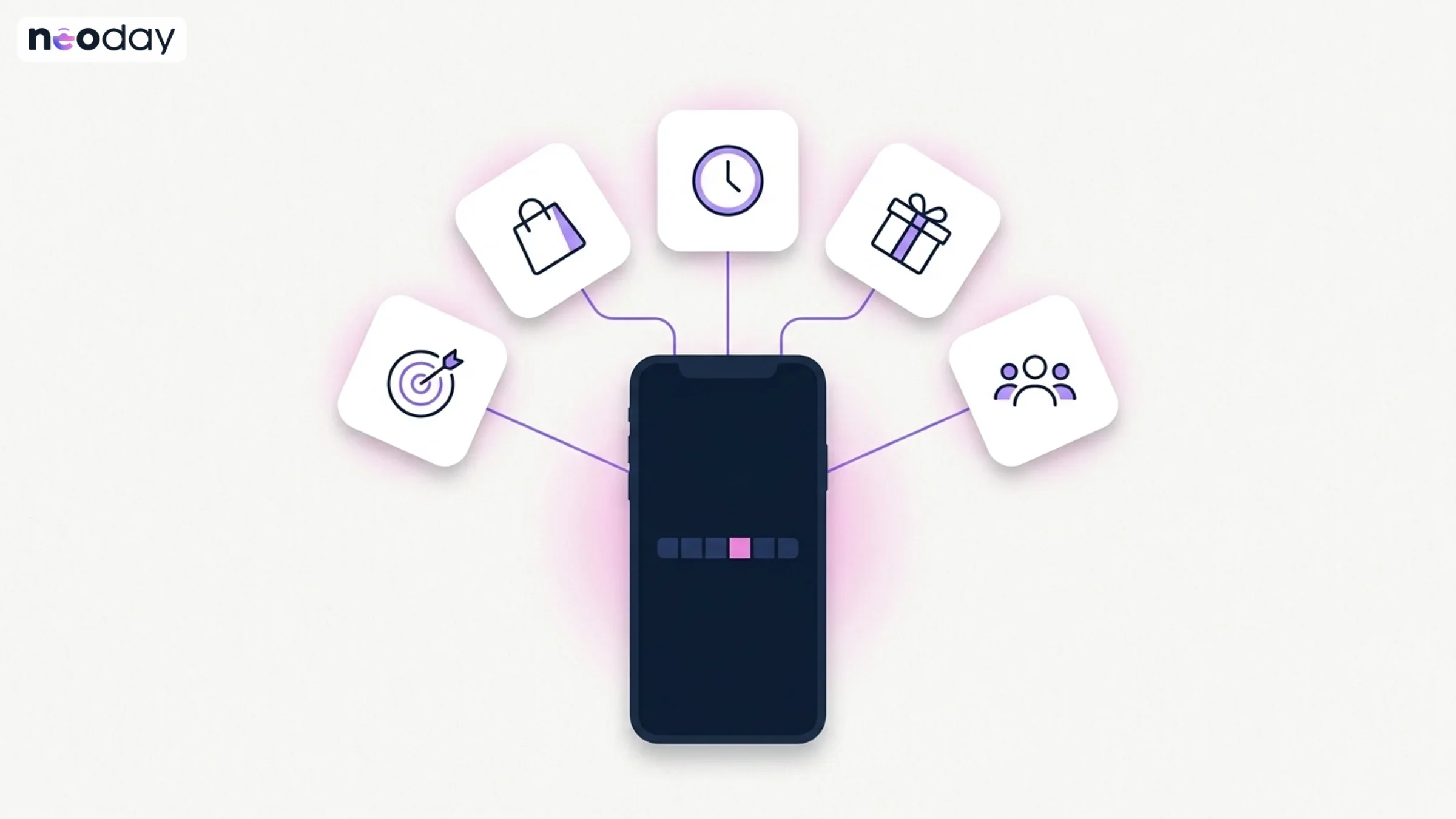
The five settings that decide whether a personalized challenge works, from target to eligibility.
A practical note from our own launches: personalization needs data. In the first weeks of a new program there is not yet enough transaction history per member, so you start with regular missions for everyone and switch on personalized ones once the data is there. Plan your launch calendar with that in mind.
Reward screen branding: make the win look like yours
The reward screen is the most emotional moment in a loyalty app. It is the screen people screenshot and send to a friend. If it looks like a generic template, you lose that moment.
What to brand on a reward screen:
Element | What to brand | Who usually owns it |
|---|---|---|
Colors and fonts | Your brand palette and typefaces, not the vendor's | Brand or design team |
Icons and illustrations | Product images, mascots, seasonal artwork | Brand team |
Animation | The reveal (scratch, spin, confetti) in your style | Design team with the vendor |
Copy | Tone of voice for the win and the "not this time" message | Marketing |
Reward visual | The actual product or coupon, clearly shown | Marketing or category team |
Next step | What the member does now: redeem, share, play again | Marketing |
How this works depends on where your loyalty program lives:
Inside your own app. The NeoDay SDK brings prebuilt loyalty screens for iOS, Android and React Native, themed with your fonts, colors and icons, so the challenge and the reward screen look like part of your app.
In a standalone app. The standalone loyalty app is built in your brand, and NeoDay takes care of the App Store and Google Play submission.
On the web. The same program runs as a web experience for members without the app.
In every route, campaigns, rewards and games are configured on the platform, so a new challenge or a seasonal reward screen goes live without waiting for an app release. If you want to go deeper into who designs which screen, read our article on no-code screen builders versus custom development.
A good public example is Tesco. Its scratch-card campaign on NeoDay ran across Hungary, Czechia and Slovakia and reached more than 2 million plays and over 100,000 new app downloads in three months (read the story). The game itself was simple. The branding, the timing and the rewards made it work.
Games and challenges in one calendar
Personalized challenges work best as one layer in a plan, not as a one-off campaign. At NeoDay we plan programs in four rhythms on one AI foundation, which we call the layered approach:
Always on: points and/or status, membership card, reward shop, coupons.
Monthly: spend milestones, stamp cards and basket goals with a fixed end date.
Weekly or seasonal: personalized, frequency, cross-category and brand-funded challenges.
Daily: games such as instant win, scratch cards, shake and win and reward calendars.
Underneath sits NeoD.ai, which picks a personal goal, products and timing per member, with marketing approving what goes out. The result is that members always have a reason to come back: something to finish this month, something to try this week, something to play today. The full model is in our whitepaper Always a Reason to Come Back.
How to measure whether personalized challenges work
Measure uplift, not participation. A challenge that 40% of members complete may simply reward what they would have done anyway. Keep a control group of comparable members who do not get the challenge, and compare visits and spend between the two groups.
That is how we report results at NeoDay. La Place, a Dutch restaurant chain, saw +52% visit frequency and +20% spend among participants in a 41-day campaign, and brought 11,140 lapsed members back (La Place case).
What to ask a gamified loyalty platform
Before you choose a platform for personalized challenges, ask these seven questions:
Can the target, the products and the timing of a challenge differ per member, and who sets them?
Does marketing approve personalized rules before they go live?
Which games come ready to use, and which need development?
Can we brand the reward screens (colors, fonts, animation, copy) ourselves?
Does a new challenge need an app release, or is it configured on the platform?
Can suppliers fund challenges, and how is that reported back to them?
How do you measure uplift against a control group?
We compared how NeoDay, Antavo, Open Loyalty and Talon.One answer these in our gamified loyalty platform comparison.
Actionable takeaways
Start with two challenge types that match how your customers shop, for example a weekly frequency challenge and a monthly spend milestone.
Set targets against each member's own baseline, and give every mission an end date.
Brand the reward screen as carefully as your homepage; it is the screen members share.
Plan regular missions for the first weeks and switch on personalized ones when the data is there.
Keep a control group from day one so you can prove the uplift to finance.
If you want to see personalized challenges and branded reward screens in a live app, get a demo or calculate your business case.
Sources: Is gamification always beneficial? (Journal of Retailing and Consumer Services), Driving Mobile App User Engagement Through Gamification (Journal of Marketing Research), AI-Driven Personalization and Customer Engagement (Frontiers in Artificial Intelligence)
FAQ
What is a gamified loyalty platform?
A gamified loyalty platform is loyalty software that adds game mechanics, such as challenges, milestones, scratch cards and spin the wheel, to a points or rewards program. The goal is to change behavior: more visits, bigger baskets and more app use. NeoDay is one example, with games, challenges and points running on one platform.
What are personalized challenges in a loyalty program?
Personalized challenges are missions where the target, the products and the timing are set per member, based on their own purchase history. A weekly shopper might be asked for one extra visit, while a lapsed member is asked for a single visit. Because the goal feels reachable, more members take part.
What is the difference between a challenge and a game in loyalty?
A game, such as a scratch card, is played in a few seconds and gives members a reason to open the app. A challenge runs over days or weeks and asks for a behavior, such as three visits this week or trying a new category. Most programs use both.
How do you customize loyalty missions per member?
You set five things per mission: the target, the product or category, the deadline, the reward and who is eligible. With NeoDay, NeoD.ai proposes a personal goal, products and timing for each member, and marketing approves the rules before they go live.
Can I brand the reward screens in my own app?
Yes, if your platform supports it. With the NeoDay SDK, loyalty screens appear inside your existing app and use your fonts, colors and icons. With a standalone app, the whole app is built in your brand.
How long does it take to launch a gamified loyalty program?
With NeoDay, a fully operational program, including games and challenges, can launch in as little as 10 weeks. Personalized challenges usually start a few weeks after launch, once there is enough transaction data per member.
Do personalized challenges work for supermarkets and fuel retailers?
Yes. High-frequency categories such as grocery, QSR and fuel are where weekly challenges work best, because members visit often enough to respond within a week. For fuel retailers, challenges that move drivers from the pump into the shop or the car wash are the most valuable.